Famiy Stories in Words and Images All rights reserved
ANNA VALBORG AND GEORG HANSENS WORLD
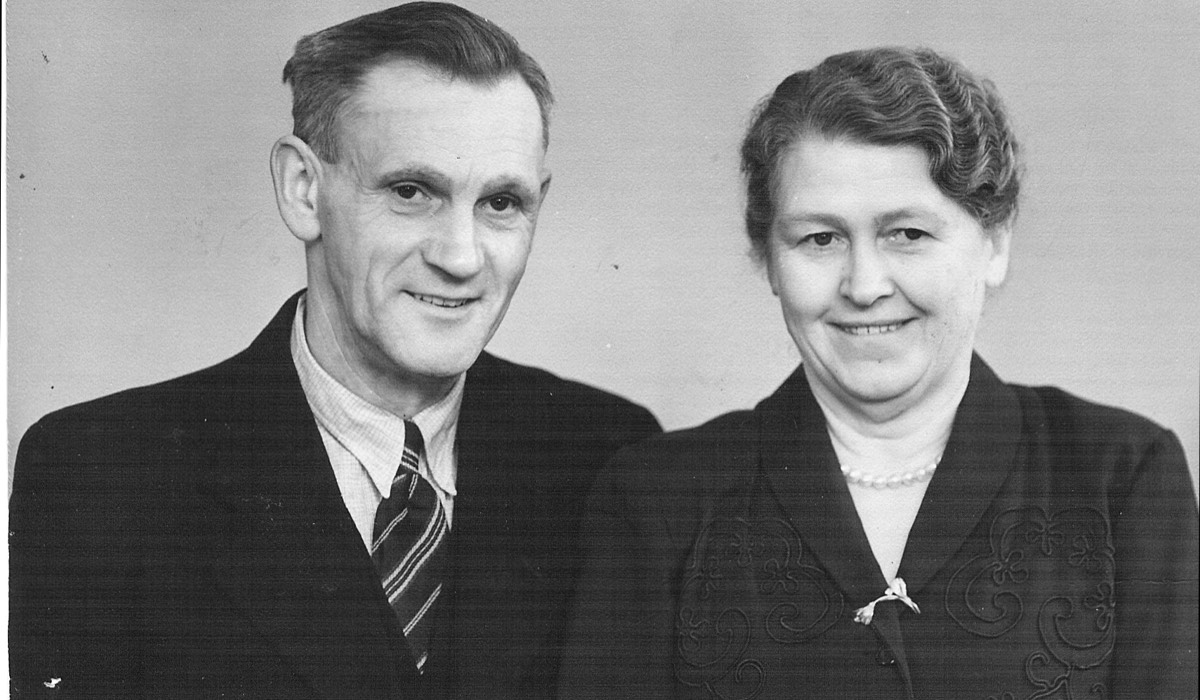
The picture shows Valborg and Georg probably for their silver wedding.
They were married in the church of Odden which has formed the framework for many baptismal acts, confirmations, weddings and funerals among the ancestors on my mother's side.
Anna Valborg was baptized and confirmed here, and Anna Valborg's mother both baptized, confirmed and buried from here.
MOTHERS MOTHER AND MOTHERS FATHER, ANNA VALBORG LARSEN OG GEORG HANSEN
But Anna Valborg, whom I have never heard referred to as anything other than Valborg (so she is called hereafter), was very much out of a significant lineage. A genus that consists not least of very strong and very brave women, which hopefully will be evident from the stories of her ancestry.
The strange thing about this case is that, according to the church book showing her birth and baptism, Valborg has no father at all. There is nothing mentioned about a father - not even an outspoken child father, as was the custom way of doing it. It is unusual, and testifies that both Grandmother Ane and mother Anna Kristine Sophie were in full control of what should appear in the parish church books about them, and perhaps especially what should not.
We have to acknowledge that Valborg did not have a known father - until we might be wiser one day.
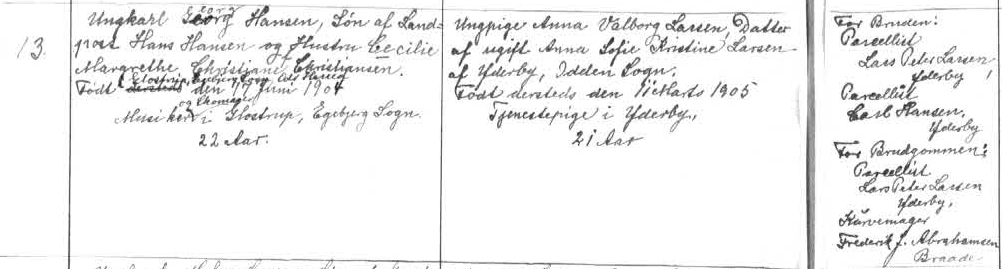
Below is the mentioned church book entry regarding the birth of Anna Valborg.


As I have experienced, they lived off the farm and the outcome could be to cultivate the plots belonging to the land, which was certainly not overwhelming. In addition, they had some animals on the farm. Chickens, a few cows and pigs, as well as a yellow Northern horse named Tulle, which I have ridden - it was big.
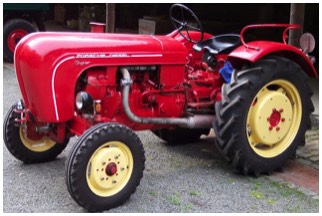
I have been with Poul out on a tractor - to my grandmother's expressed dismay - which I today fully understand. Back then I just thought it was some girlish shit. Poul seemed happy, and I have suspected him a little for liking much of teasing his big sister as well. And here was an obvious chance. Well, but I came up to sit in the shackle on the screen and Poul started, giving it gas. Then we drove full speed down the field road that went all the way from the farm and down to the water (Kattegat). Poul used snuff, and therefore had pretty black teeth, and although I struggled to hold on, on the screen of the screen and in Poul, so as not to fall off the tractor at full speed, I could see in his ever-growing black grin that he was amusing himself on the whole trip. I have to admit today that I was scared during the trip and that it was actually very dangerousl. But afterwards I was not able to shoot through - even though I was pretty sore in the back. It was amazing.
And Poul got a good time scolding-out of Valborg, which he also amused himself dearly.
The story I've always heard is that the Porche should also turn out to be Poul's death, but new information from a kind soul in the ward council at Odden has disproved this story. The story I know goes that he overturned with the tractor on the field and got it down over him - which also fits very well with his hung to run the race with the Porche. However, the story does not fit, as I have now found that Poul at one point sold matr 9c, and bought a smaller house next to where he lived, and turned over 80 years. Poul was buried from Odden church by his good friends and neighbors Susanne and Niels Madsen on December 29, 2001.

All these things (though not Poul's old age and death) I have experienced when on my summer vacations with my grandmother and grandfather, we sometimes visited Poul and my grandmother at Odden.
I have actually spent many a summer holiday at Valborg and Georg in Glostrup, Egebjerg, and as I remember my grandmother, she was what I would call a real Grandmother. She was really good at cooking, and it was at the beginning on an old stove with iron rings, where she, with an iron hook and a bucket of tree knots, was a bit of an equilibrist with cook rings, pots, pans, and firewood. It smelled wonderful! Here she prepared the most tasty food imaginable. I especially remember her gooseberry soup - yes, it may not sound very exciting, but I can promise it tasted so you just had to gasp until the physics said natural stop. She was never cheap about sharing her food. And then she used her skills in the kitchen to create dialogue - we always talked while she made the food and while we ate it. It was safe, and it was nice - and she probably got as much information about the family as she needed to get.
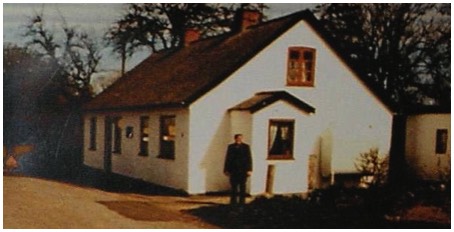
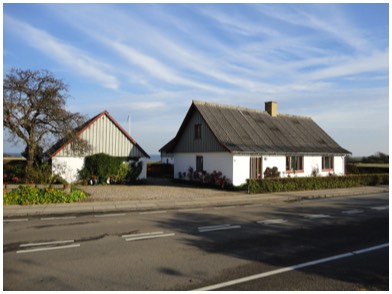
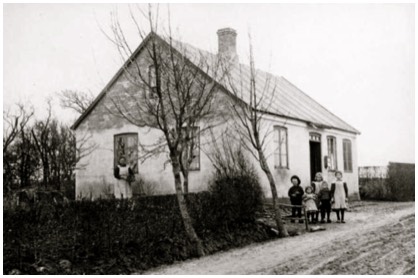
My summer holidays were held here on Glostrupvej, Egebjerg in the smallholders place with chickens, meadows, orchards, and a wash boiler in the hen house. I lived in the attic room seen here in the gable - and it was a real attic room. There was a chicken ladder from the back hallway and up to the attic, which actually served as a storeroom, where at the one end a door was set up and two beds were placed behind the door. The quilts in the beds were of the type that keep the guests in place. Once you got one quilt over, you didn't move until you woke up again. I remember the night pot under the bed, the smell of moisture from the walls and duvets, the roaring black darkness and the corresponding utter silence of the night that only existed in the countryside where there were no street lights or traffic. It was very special experiences for such a Copenhagen boy like me, who was used to trams and cars making noise on illuminated streets just below our windows throughout the night. But it was a wonderful time with lots of completely different and wonderful experiences, sounds and smells. The picture here shows in the background the outhouse which had many functions. Here was the hen house, the chicken farm was in the front left of the outhouse and just off the back door of the house where my grandmother was constantly rushing out with peels and other waste from the cooking. Here was a wash boiler, which I think my grandmother sometimes used to wash, and here was a garage for my grandfather's most important tool, his bicycle. Just in front (to the right of the outhouse) was the meadow, right on the edge of the orchard with gooseberry, black currant and rib bushes and lots of apple and morel trees (causes of more than one stomach ache in little Peter's stomach), and then the fields came to the farm that belonged to Gunner Olsen, who was one of two sons to the residence just across the road.
It was at Gunners farm that I spent most of my time on my summer holidays in Glostrup. Gunner, with the scale of the time, had plenty of animals on the farm. He had pigs, cows, bulls, calves, a big barn with a mighty hay loft, and a lot of cats that could catch the mice.
I loved spending time in the cowshed, and especially with the calves, often placed in an empty pig fold. Here I learned the calves to drink milk by holding one bucket of cow's milk under the calf's muzzle, and then put the other hand into the milk and then let the calf suck on his hand. That way I was able to get my hand and the calf's mouth down in the bucket with milk very slowly, and the calf just kept sucking. The art sometimes consisted in getting the hand out of the calf's mouth again - such a calf sucks so vigorously I can say. Many times I have laid and slept for dinner with the calves in the fresh hay in the pig fold. It was a wonderful warm and present feeling and I had a great relationship with the calves. Better summer holiday in the countryside I can not imagine. And the smell of the suitcase when I returned home did really "amuse" my mother ☺ .
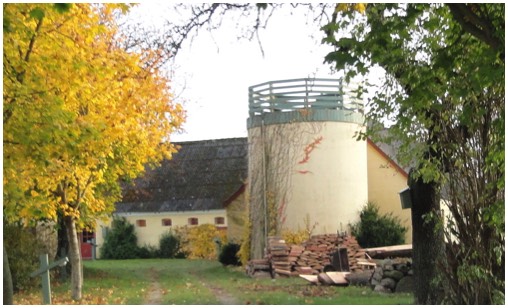
But I was also involved in the practical work on the farm. For example, I helped feed the animals. There was a large silo at one end of the pig barn. The silo is seen at the front in the picture here, which is from 2010. The stable (the original) is right behind the silo. I do not recall the barn building to the left of the silo, so it may be of recent date. The barn is not visible in the picture, but it is perpendicular to the newer building and opposite the original barn building. Further back is the farmhouse which is also not visible in this picture. The farm was originally a three-storey farm, with farmhouse, barn and stable. The silo was where Gunner stored silage, which is such a mushy, fermented mass of beet tops, other greens, and grasses that were used as feeders for both cows and pigs.
This is how silage smells, and that smell stands out to me today, along with the usual smell of barn, as the epitome of "the country". I was also involved in cleaning the stable, and I cleaned cows when going to the slaughterhouse or on the show. Once, I started stroking the bull at a time when Gunner was not even close, and it was about to go completely wrong. For the bull does not seem to like the fact that I tore and peeled the lattice in the dried cakes on its thighs and legs, so it started to push me up against the barn wall as it stood up. And such a bull is strong I can tell, so it was a fantastic luck that Gunner just got into the stable enough time to get the big and sour bull in the tail so that it released the pressure on my not so big body and I could slip out. I have not laced bulls since !!
I also helped drive hay in and stack it on the hay loft, and I was also allowed to drive the tractor myself. In fact, I was allowed to drum a whole field - and it happened to be the field facing my grandmother and grandfather's orchard, and so I thought I could park the tractor in the field just behind their house to go in and eat I had to go out again and finish the drum. That decision my grandmother did not quite agree with, I can clearly remember - she did not think I was old enough to drive large machines in the field. I couldn't understand that at all. After all, I had been allowed by Gunner, and he had given me a good education on how to drive the tractor and how to raise and lower the drum. Besides, I was a big boy and I could handle myself (at least I was 10 years old). So what could the problem be for Grandma?
Well - but then I got the drum done.
One of the best things I knew was, at dinner time, where they in the countryside was at noon. They were all sleeping after dinner, si I was lying on my back in the tall grass behind Gunners big barn, and just looking up into the sky, watching the fantastic escape of larks and swallows while enjoying the absolutely beautiful sounds of all the birds.
Inside the barn there were a lot of machines, both old and new, and it was incredibly exciting for me to explore this cornucopia of new and old technique. On top of the barn there was a big hay loft, and here I had set up my own cave where I could hide with the cats, sleep for dinner, and just be myself. It was a freedom that cannot be compared to anything else.
I remember my holidays in Glostrup, Egebjerg as the most life-giving of my childhood, and as something that really helped to shape me as a human being afterwards.
I would not have been without that in my life.
Valborg got married on November 17, 1926 in Odden church with Georg Hansen - my grandfather. A wedding where Lars Peter Larsen, Anna Katrine Sophie's husband and Valborg's stepfather witnessed both bride and groom.
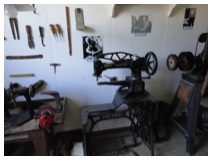
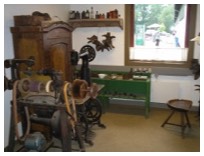
Georg Hansen, my maternal grandfather, is to that extent a personality who has left his mark where he lived, both in his present and subsequent years. For example, an entire section has been created about him and his life at the Anddelsmuseet Nyvang in Holbæk.
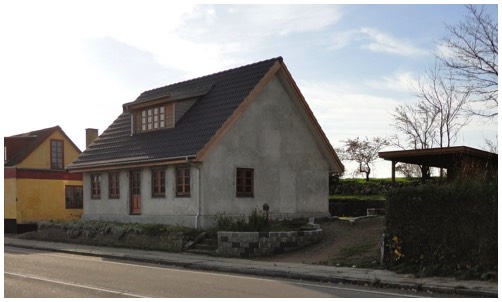
Georg was born on June 17, 1904 in the house here at Glostrupvej 33 Egebjerg, which he lived throughout his life. The house was built by Georg's father Hans Hansen, in 1895 where Hans' and and his wife Cæcilie move from Hølkerup, where Hans was an lodger at Gårdmand Lars Peter Larsen, to Glostrup, and where their social status changes from being Lodger people to being House people.
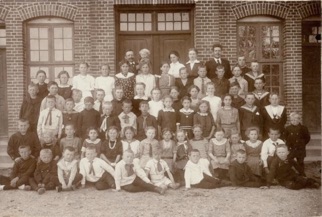
Georg is number nine out of a sibling-flock of ten, the first born in 1884 and the last in 1906. Five of his brothers emigrated to the United States (read the stories about them here). Georg's father was a country postman Hans Hansen born in 1854 in Højby, and his mother was Cæcilie Kristiane Margrethe born 1864 in Egebjerg.
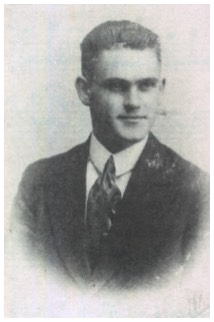
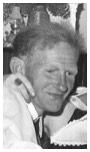
To the right is Georg as a very young man probably in the age of 16-20 (1920-1924)
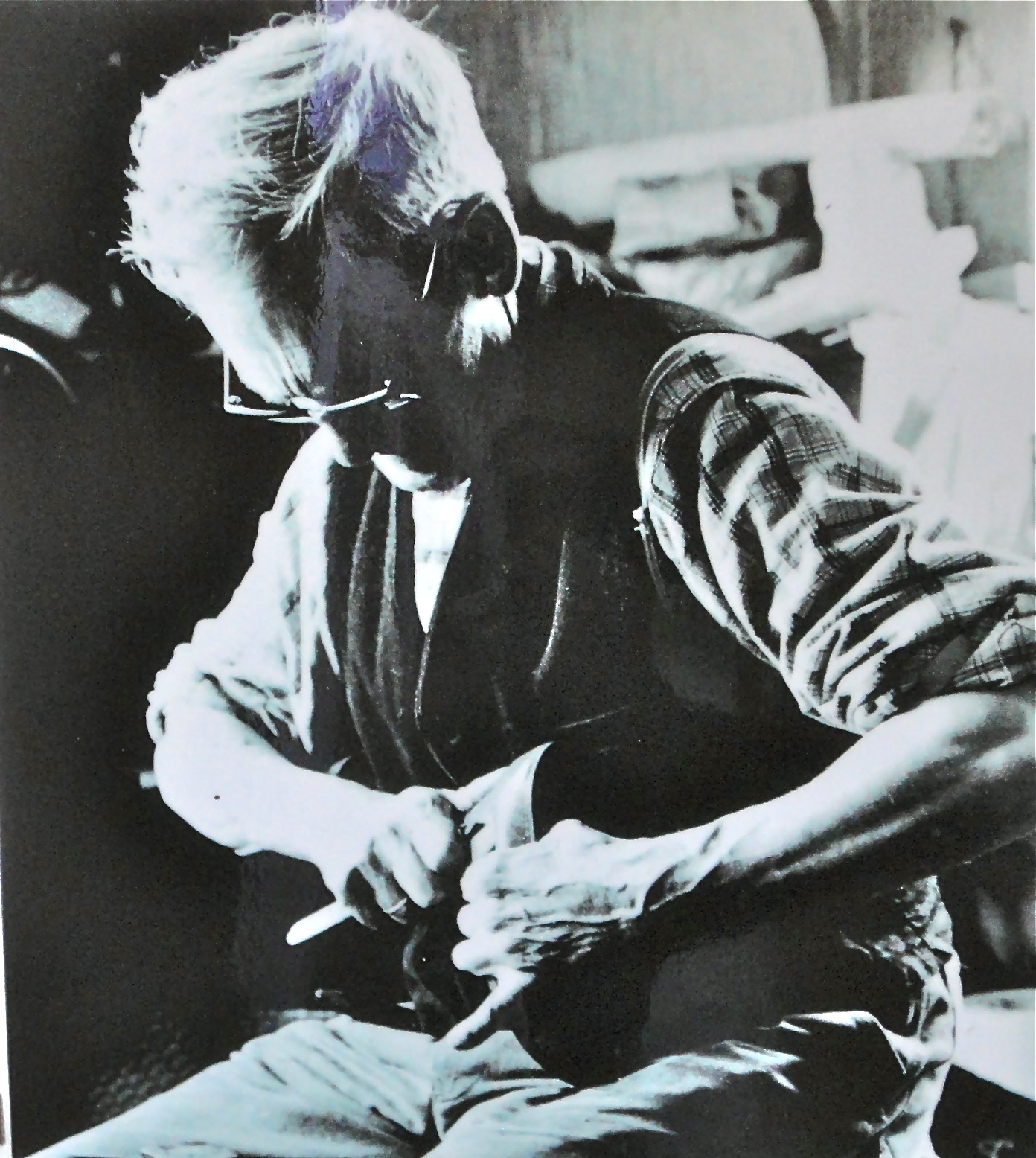
So the shoemaking was not Georg's only job. As mentioned, Georg's father was a postman, and Georg followed his paternal master, and it became his main source of income throughout most of his life. At the same time, this job was one of three jobs that contributed to the fact that Georg had a physique that one must otherwise look for long. The reason is that the post in the country was brought out by bicycle, and since there could be quite a long distance between houses and farms out there, it became quite a few miles every single day. At the same time, the area Egebjerg, Glostrup, Bråde, Vig is quite hilly, so it was not the kilometers alone that gave Georg this fantastic physique.
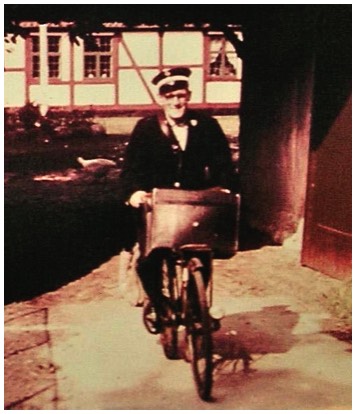
The same bike was used for the other jobs that kept Georg in super physical shape.
One job was to ride with the joy of Christmas a couple of times a year, cycling around several parishes and gathering so people were sure to have a little something to sweeten the time at Christmas.

Georg and Valdemar had taken off on their bikes from Glostrupvej in the afternoon, heading for Yderby, Odden - a trip of exactly 30 km in a sometimes hilly terrain. They played the best they had learned at the party for brides, grooms and guests, and only at night did they return to Egebjerg again. It had just happened in the meantime that a violent blizzard had erupted all over Odsherred, and they were definitely not dressed for blizzard. In fact, they were just wearing their usual play clothing, which probably consisted of a finer shirt, thin pants, party jacket and thin shoes. Well, but George was not easy to scare, so they climbed the bikes and started a 30 kilometer battle against the elemental race. Wearing thin clothes. They fought and battled against the storm, the cold, and the snow, and when they had come some distance, Valdemar would no longer. He sat down in the ditch and told Georg that he could just keep going, so he would stay there himself until the weather got better.
But that did not work with Georg.
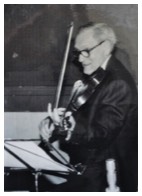
Here are some great stories about Georg and his musical world and journey through the ages.
And it is certainly not uninspiring reading.
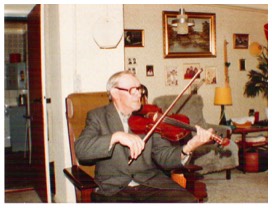
Here, in his older days, Georg gives a number on the violin in the living room in front of the chimney.

My memories, most importantly from my holidays in Glostrup, about Georg is about an always smiling and happy man who was always involved in something. But he was also a good guy. For example, in Valborg's kitchen, no running water had been added yet, so there was a pump at the kitchen sink that could fetch nice cold water out of the well. It used Georg every night to wash - and it was in cold water and in the kitchen sink. First he washed his face, and then hands and arms with a nail brush and coarse hand soap. But the teeth should also be cleaned. So when he got done with his face, hands, and arms, he took out all the dentures and gave them a ride with the nail brush as well, and then they just got a squirt from the pump afterwards, and then fit in with them again. Not so much fuzz.
Another good example is about a slightly more taboo part of the human body.
It's not hard to imagine that Georg, who stayed in the saddle on his bike for much of his time, could easily be plagued by problems with the rear. But there was also a way to handle that - at least when you were Georg. He filled one hollow hand with plain liquor and tossed it into the back. Quiet and easy, and without a sound. It could keep most problems away, he said. This small fix, my father - Niels Vagn, who also suffered from hemorrhoids, should also try once we were on a family visit with my maternal parents. At that time, they had been given both running water and tow-and-drop toilet on Glostrupvej 33, and my father therefore, with the liquor bottle, withdrew to the toilet to solve his problem. I never think I have heard anyone howl that way before or since. We simply thought the whole house was going to collapse on our ears, that's how he screamed. At any rate, no one could doubt that it made off on my poor little father's buttocks. If that helped him, the story doesn't tell, because he wasn't very talkative afterwards. But it was actually quite entertaining and at least it tells a story about what kind of stuff Georg was made of.
I hope to have inherited just a little bit of his amazing energy, diligence, kindness, and courage.
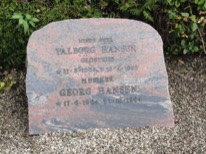
Georg died on October 1, 1994 in Egebjerg.
They are both buried in Egebjerg cemetery.
Peter Kroman ©